
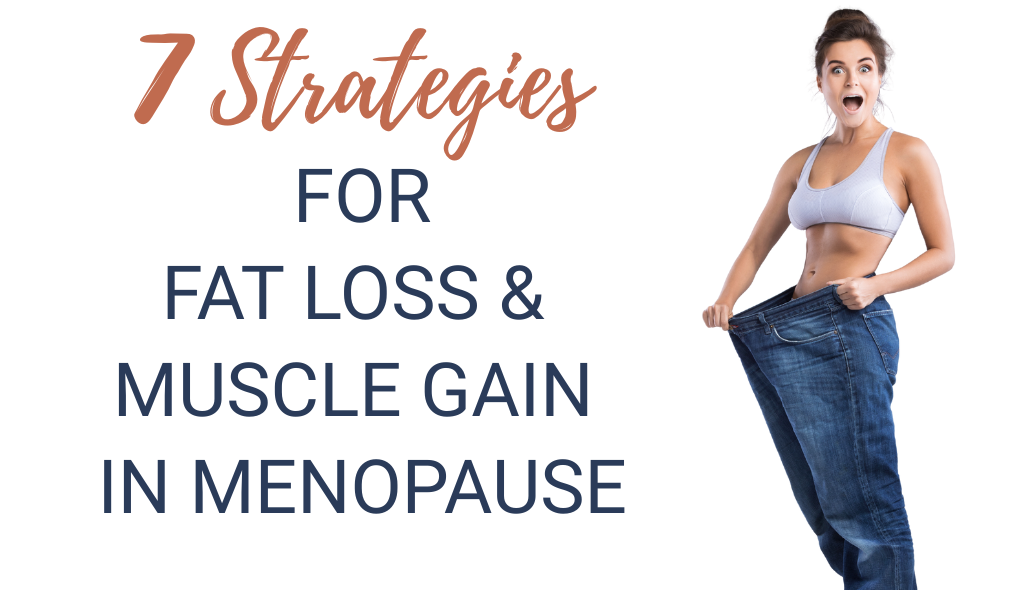
If you’re a woman in your 40’s to 50’s and maintaining your shape and size suddenly feels harder – or completely stalled – you’re not imagining it nor are you alone in your frustration. Inability to lose fat and especially the appearance of belly fat is easily among the top 5 complaints I hear from my midlife clients (the others are brain fog, hot flashes, exhaustion and inability to sleep). If maintaining your shape or losing fat never used to be a struggle before now, it can be a big shock to suddenly find yourself battling your body’s changing composition. My clients will often tell me that they’re not eating anymore than they used to and they’re exercising the same as they did in their 20’s and 30’s, yet the weight just started piling on “all of a sudden”. Many women exhaust and / or starve themselves while trying every fad and gimmick they come across, only to see no lasting improvement in their physique or the fit of their clothes. Others blame themselves, believing it must be a lack of motivation or discipline and resign themselves to being stuck with their body’s new shape.
Ladies, have no fear, all is NOT lost! PLEASE allow me to give you hope by educating you on what’s actually happening with your body and giving you the tools you need to take your power and your body back! You are not stuck, you do not have to settle for this new shape if you don’t want to. This blog post will help you understand what is happening inside your body that results in changes to the outside of your body, and what you can do to reverse those changes.
Changes In Hormones Cause Changes In Your Body Composition & Metabolism
Menopause is not just a reproductive milestone slotted on the calendar like a national holiday. It’s a whole-body transition that affects every major system in your body. You can’t think of estrogen as the teacher in a pre-school classroom. When she’s in the room, the toddlers play well together. The rules are understood and followed by all. When she leaves the room, chaos ensues! Something similar happens in our bodies during the menopause transition. When Ms. Estrogen leaves the room, our metabolic processes go haywire, causing weight gain, fat gain, muscle loss and more. This is because estrogen plays a critical role in:
- Where our body stores fat: Here’s a not-so-fun fact for you….Postmenopausal women are five times more likely to develop abdominal obesity compared to premenopausal women. As estrogen declines, our body shifts fat storage from the hips and thigh areas to our internal organs instead. Since most internal organs are in our midsection, belly fat increases as the fat around our organs increases (called visceral fat) even though caloric intake may not have changed.
- The amount of fat versus muscle: Estrogen helps maintain muscle mass. As it declines, we lose muscle which results in fat gain even though our exercise routine may not have changed.
- Signals that tell us to feel hungry versus full: estrogen works with the brain center’s hormones to signal “feeling full” to stop us from eating. Declining estrogen leads to cravings and weight gain from over-eating whereas craving control and caloric intake might not have been a battle before estrogen began to decline.
- How efficiently we burn calories: Estrogen helps maintain a high rate of calorie-burn while at rest. As estrogen declines, our body burns 200-300 fewer calories per day at rest. This means that even though you’re eating the same and working out the same as before, your body isn’t burning the same amount of calories. The result is excess caloric intake compared to expenditure each day. If you aren’t strength training more than before, then those extra calories aren’t being used to create muscles, they’re being used to increase your body’s fat stores.
- How much inflammation we have: Estrogen acts as an anti-inflammatory, protecting against autoimmune flares, join issues and chronic inflammation.
Collectively, these physiological changes result in increased fatty-tissue and decreased muscle, forcing us to change our tactics to maintain our body shape and size. This is supported by research, which indicates that 70% of women gain ~1.5 pounds per year while going through the menopause transition, even when they maintain their normal fitness and nutrition routines from pre-menopause. The menopause transition lasts about 10 years, which adds up to ~15 pounds of hormone-related weight gain during your 40’s to 60’s.
Strategies You Can Implement Now To Regain Your Pre-Menopause Shape and Size
First, it’s super important to clarify what we mean when we say “weight loss” or weight gain. Too many women are hyper-focused on the number on the scale. When we talk about weight loss at TSP, we’re focused on decreasing fatty-tissue more so than decreasing the number on the scale. We don’t actually care how many pounds you weigh, but we do care about the % of body fat versus muscle. We want to see the fatty tissue number decrease and the muscle tissue number increase for optimal health. Flowing from that will be positive changes in your body size. That can happen without the number on the scale decreasing, or it may even increase a little as you add muscle while positively improving your overall body composition. Menopausal weight gain is the bad kind – it’s increasing fatty tissue while muscle tissue is decreasing.
You are not powerless amidst these changes. A holistic, personalized approach that focuses less on the number on the scale and more on non-scale victories is best, leveraging a multi-pronged attack that is designed specifically to overcome menopause challenges includes. Here are areas you can focus on to regain control of your body size and composition of muscle versus fat.
1. Stop Starving Yourself – Fuel Your Body To Support Your Metabolic Needs
Nutrition is the most overlooked tool in your toolkit for maintaining or losing weight and improving your body composition (fat versus muscle). I suspect it’s because it feels really complicated and science-y so people steer clear of it out of fear. The other reason is because humans want to do what they want to do, and not feel restricted in any way. Making healthy food choices feels like a food prison to some. Either way, it’s not complicated and a few simple mind shifts can make all the difference in your success without feeling restrictive. If you learn nothing else from me about nutrition, please let it be these three fundamental strategies that you can implement to regain control of your body in menopause..
Food is fuel for your body, you cannot starve it and expect to be healthy. For the love of all gods and goddesses, STOP THE DIETING INSANITY. The number one mistake women make is to believe the magazines and social media influencers who’ve convinced them they should only eat 1,200 calories per day. For the record, that’s not even enough calories to sustain your body’s basic functions like breathing and pumping your heart. Under-eating causes a number of metabolic crises that you really want to avoid.
Let’s review the facts about calories. 1500 calories is the bare minimum of what menopausal women need to simply exist – as in sitting on the couch, breathing, blinking, digesting your food and pumping your heart. That 1500 calories is BEFORE you add the additional calories needed to fuel your exercise activity. You need to know the total picture so you can consume enough to not only survive, but to thrive in whatever activities you have planned.
I prefer to use the calorie equation developed by Mifflin-St Joer, which is widely used by personal trainers and medical professionals to determine your Total Daily Energy Expenditure (“TDEE”), a fancy name for the amount of calories you use in a day. The formula takes into consideration your height, weight, age and activity level (e.g. sedentary, light activity, moderate activity, heavy activity).
[icon name=”calculator” prefix=”fas”] To find out how many calories you should be consuming to meet your health and fitness goals, hop on over to TSP’s calorie calculator. It’s super simple to complete, and will give you a valuable new insight for planning your daily nutrition and exercise.
2. Eat The Right Amount Of Macros – Prioritize Protein, Make Healthy Carbs Your Friend, And Stop Fearing Healthy Fats
You cannot out-train what you put in your body. The type of food (macros) and the quality of food (whole, fresh vs. processed) matters. This is where macros and healthy food selection comes into play, even more so now that estrogen is declining or has completely left the building. Within the calories you consume, each calorie or type of food can be classified into one of three categories: protein, fat and carbs. These are known as macronutrients or “macros.” Each of the three macros serve a distinct purpose, so the amounts of each that you consume should be tailored to your daily activity needs and body composition goals – all within your total calorie count.
Since estrogen plays a major role in muscle composition, we lose muscle as estrogen declines. This is why everyone and their sister, cousin and neighbor on social media talks about PROTEIN, PROTEIN, PROTEIN. Menopausal women should prioritize their protein intake to combat the sharp decline in muscle mass. Lean proteins are best. I recommend the following macro ranges for a woman in menopause. These are broad ranges to get you started, but should ultimately be further customized based on your individual fitness and body composition goals and considering underlying health conditions. Choose fresh, minimally processed, healthy sources of food to lessen the processing burden on your digestive system. Load up on brightly colored fruits and veggies, as they will provide you with the fiber, vitamins (especially Vitamin D), minerals (Calcium) and nutrients your body needs for optimal health.
- Protein = 30% – 40% of your daily calories (essential for maintaining / increasing muscle)
- Carbs = 30% – 40% (necessary building block for energy / to fight fatigue)
- Healthy fats should be 20% – 30% (helps with nervous system function, hormone function and inflammation)
- If you’d like to learn more about macros and how to tailor the ranges above to your specific goals, click here to receive our free TSP Menopause & Macros guide: YES! Please Send Me The Free Macros Guide
3. Time Your Meals Smartly To Match The Demands Of Your Activities Throughout The Day
When you eat is just as important as what you eat. Poor timing of your meals and snacks, and more specifically macros, can disrupt your hormones further, decrease your energy during your workout, slow your recovery, disrupt your sleep and cause hangriness on top of your Meno-rage. Women tend to eat very little early in the day, and then scarf all of their calories at dinner or later. If you’re menopausal, you need protein earlier in the day to make and maintain the muscle you’re trying to build. Also, the human body can only process so much protein in one sitting. Likewise, women have been brainwashed by diet fads over the years to believe all carbs are bad. The truth is that healthy carbs are a necessary source of energy, which means we need them to fuel our workouts or any other intense activities we’re pursuing during our day. Broad timing recommendations are as follows, with more customization required to tailor to your training schedule and lifestyle.
- Protein: Try to take in about 1/3 of your daily protein within the first half hour after an intense training session, spreading the rest around evenly through the day’s meals. For a non-training day, spread intake evenly across meals
- Carbs: Prioritize intake around training times, and spread the rest across meals for the day.
- Fats: Spread evenly across meals through the day
- Generally avoid eating within two hours of bedtime to avoid having digestion disrupt your sleep
If you want step-by-step guidance on how you can get step-by-step guidance on how much protein, carbs and fat you should consume in menopause via our blog post here. For tips on selecting healthy sources of foods, you can review our blog post here. For a visual guide to help with portion control, check out our blog post here.
4. Quit Avoiding HIIT Workouts Because A Social Media Influencer Told You It Raises Your Cortisol
For that matter, let’s just agree here and now to stop listening to social media influencers (and ChatGPT) who are NOT certified personal trainers, not certified nutrition coaches, and not certified menopause health coaches. Would you go to your plumber for health and wellness expertise? No? Exactly. So don’t trust nearly-naked 24 year-old Susie-Q in all her photoshopped glory to give you evidence-backed exercise and nutrition guidance appropriate for menopausal women. [Steps off soap-box.]
It’s no wonder that women are confused about what type of exercise they should be doing during perimenopause and post-menopause to optimize their health and longevity. Allow me to cut to the chase and share evidence-based recommendations with you. Staying active is key, providing more benefits than just weight loss. The negative effects of decreasing estrogen on our cardiovascular system and musculoskeletal system are far-reaching. Coupled with nutrition, EXERCISE is one of the most powerful tools in our menopause toolkit.
Repeat after me: Cardio is good! Executed properly, it will not destroy your cortisol or your joints. Just like nutrition, all cardio is not equal in terms of effectiveness and efficiency. This means the type of cardio and timing that you were doing in your 20’s and 30’s needs some tweaking in response to our changing hormones now that we’re in menopause. Numerous studies in recent years conducted on menopausal women continue to prove that high intensity interval training (“HIIT”) is still best for improving our ability to burn more fat, push fuel into our muscles, improve insulin sensitivity, and overall cardiovascular endurance. HIIT provides the metabolic “green light” our body needs to boost the changes to our body composition. Before estrogen left the building, it provided that green light for us. This is why the workouts we were doing before menopause suddenly seem to not be working anymore. If you were doing HIIT before, the tweak you need to make is to turn up the intensity within each workout a little bit while turning down the volume (the number times per week we do a high-intensity workout) and allow yourself true recovery days between workouts. If you weren’t doing HIIT at all before, there’s no time like the present to get started.
Check out our free HIIT Workout Guide for easy to follow exercises you can do at home with no equipment required.
5. Start Lifting Heavy While Tossing Aside Your Irrational Fear It Will Make You Bulky Like The Incredible Hulk
Strength training is non-negotiable in menopause. To build muscle and strengthen your bones, you have to lift something heavy 2 – 3 days per week. The more muscle you have, the more calories your body burns while at rest, so strength training can help you get sculpted and lean while increasing energy. In the infamous words of Stacy Simms, it’s time to Lift Heavy Sh*t. Marketing gimmicks of the past have taught women to lift lighter weights for high repetitions with the promise of getting “lean and sculpted.” Apparently women fear getting “bulky like a gym bro”, thus the genesis of low weight / high reps. This is non-sensical, and actually hurts women because our hormones, muscle mass and strength decline sharply as estrogen declines. We HAVE to lift heavy just to offset the muscle and strength loss.
Do you want someone else helping to lift you off the toilet when you’re 80? No? Then pick up something heavy today and lift it, damn it! Quit worrying about looking bulky, I promise lifting a heavier dumbbell isn’t going to automatically make you look like The Incredible Hulk. Heavy lifting will increase your metabolism, helping burn more calories and those fat stores we talked about earlier, helping you combat the meno-belly and improve your body composition. This is actually how you achieve the “sculpted” look because to be sculpted means you have to build tight, firm muscles that replace the soft, flabby fat! It ain’t gonna happen with 20 reps of those cute little pink 2-lb dumbbells.
TO receive a free one-week strength workout click here:
6. Decide Once-And-For-All That A Healthier You Is Worth The Investment And Make The Commitment To Your Future Self
Weight loss, nutrition and fitness plans often fail in the first 1-2 weeks because they aren’t accompanied by behavior changes that are required to support the weight loss plan. You must emotionally and mentally commit to making changes. Start by viewing food as the special ingredient to your fitness, weight loss and health goals. The goal is not to restrict your options, nor to eat perfectly every single day. Your goal is to eat foods that give you energy, make you feel healthier, help you achieve your fitness goals, AND that you also enjoy. To further support the mental shift, consider implementing some of these lifestyle changes to increase your success:
- Meal-prepping & batch cooking
- Frozen fruits & veggies or pre-chopped, ready to cook
- Pre-cooked meals from the grocery / deli
- Proper sleep so you feel like exercising the next day
For more help with changes to lifestyle and tips for success, check out our Macros for Menopause Series post “Five Easy Ways To Outsmart Menopause By Eating Healthier (Without Making Nutrition A Full-Time Job).”
7. Educate Yourself On Medication Options That Safely Support Your Goals To Reshape Your Body And Improve Your Overall Health
Health and fitness are team sports so sometimes nutrition and exercise need a little help from their teammates at the pharmacy. Whether prescription or over-the-counter, medications and supplements can be a valuable tool in your menopause weight loss toolkit, and there should never be any shame associated with deciding to use these tools. These methods may be necessary to transform your menopause experience, or to give you the boost you need to get over a particular hurdle. Options here could include Hormone Replacement Therapy (“HRT”), GLP-1s, and / or supplements. HRT is not a weight loss method in itself, it won’t lead to immediate weight loss. However, it does help balance your hormones which can counteract the negative effects outlines above of declining estrogen. HRT may also help ease symptoms which are contributing to your inability to lose weight (like better sleep means you feel like exercising the next day). GLP-1s can help women lose significant weight but should be paired with nutrition and exercise plans to prevent severe muscle loss and nutrient deficiency. Supplements and botanicals can also be a helpful tool, especially for women who aren’t candidates for HRT. Several supplements have been studied for their ability to alleviate menopause symptoms, and the results are promising.
We’re thrilled that the FDA recently removed the black box warning on HRT medications. To learn more about HRT, read our blog post “Top 5 Myths vs. Facts About Menopause Hormone Replacement Therapy (HRT) & Treatment Options.” If you’d like to gain a better understanding of weight loss drugs called GLP-1s, check out our recent post “Will GLP-1s Help Me Lose Menopause Weight and Get Rid Of My Belly Fat?”
Give Menopause The Middle Finger, Get Started Today On Becoming Fit, Feral & Fabulous!
Your health and wellness deserve the same devotion as your 401(k) or your savings account. In the same way that you must make deposits into your 401(k) if you want it to grow into something worthwhile that you can use in the future, you must also invest in your health. Unfortunately there isn’t a magic wand. If you want to be healthy, fit, sculpted and lean, you have to commit to the time and effort it takes to accomplish those goals. You can get started today by. making can smarter nutrition choices and implementing a good fitness routine.
Soon we will be launching an exercise and nutrition app specifically for menopausal women. If you’d like to stay updated on our progress and launch date, sign up for our newsletter here:
We hope you find this post helpful and that you feel equipped to implement strategies that will help you lose fat and increase muscle in menopause. For more menopause health and wellness insights and tips for how to be fit, feral and fabulous, sign up for our email newlsetter here, browse our website and follow us on our socials: That’s So Perfect on Facebook and That’s So Perfect on Instagram.
Cheers!


