

Authors: Lori Parsons, founder of That’s So Perfect! and Callie Parsons, Senior Communications Major & AXO at The University of Tennessee
This post is part one of a three part series, developed in collaboration with a rising senior at the University of Tennessee and her mom. We’ve revisited everything we did to get her ready for her freshman year, including the successes, the mistakes, and the things that took us by surprise. Together, we scoured numerous books and online resources and talked to other experienced and newbie college parents. The end result is a consolidated set of easy-to-follow guides for you and your student. The guides cover everything from financial readiness and personal safety to what to buy for the dorm. We’ve done the planning, the list-making and the organizing for you. Callie and I have put together a collection of the best products to make it easier for you. Take a deep breath and relax. We’ve got your back!
I know, mama, I know. This whole “sending your student off to college” thing is an emotional roller coaster. On one hand, your mama’s heart breaks every time you think about dropping them off at their dorm or apartment, especially if it’s the first time or first kid. My daughter is going to be a senior at The University of Tennessee in Knoxville. That means she’s about 7 hours away from home. I still cry every single time she heads down the driveway and back to school (so does my husband). On the other hand, you’re so excited for this adventure they’re about to embark upon, and you have so many hopes and dreams for their future.
I’m not sure if you realize it or not, but your student is on the same roller coaster ride with you, just from a different perspective. The anticipation is killing them – they can’t WAIT to get to campus and do whatever they want whenever they want 🤣🤣🤣. You and I both know that’s not really how college life goes, but we’ll let them learn that lesson on their own. Deep down, though, our student is probably afraid to let you see that they’re scared because they don’t want to give you a reason to say “please don’t go, stay here and go to the local community college.” Perhaps they’re scared of so many big changes all at once, or of being far from home, making new friends, going through greek rush, living with new roommates, finding their way to class, being responsible for themselves. The list goes on, but my point is that your student may be putting on a brave face just as much as you are. You’re both trying to help each other hold it together over the months leading up to college move-in day.
I expect someone, somewhere will try to compare these guides to helicopter parenting, so let me clear the air on that one right up front. Raising good human beings who can take care of themselves and be productive participants in their community is always my goal. I am a no B.S. parent. The difference between being a prepared parent versus a helicopter parent is that being prepared means anticipating the challenges your child will face in life and proactively teaching them the skills needed to navigate themselves through those challenges if / when they occur. It also means teaching them how to learn from mistakes, because they’re going to make many of them.
Nothing in these guides is intended to promote “helicopter parenting.” Quite the contrary – our purpose is to raise awareness of the steps you and your student need to take, and the skills your student will need to be taught so that they can go off to college and be responsible, safe, successful, independent young adults. Emphasis on “independent!”
Lori Parsons, Founder of That’s So Perfect!
Here are the topics discussed in this post:
What To Do 4 – 6 Months Before Your Student Moves To College or Trade School

SCHOOL SOCIAL MEDIA ACCOUNTS: Don’t forget to also look for a student housing account, they’re often separate from the main university social account. They may post video tours of the rooms on these accounts. Don’t forget to look on Instagram, YouTube and TikTok. Universities aim this content at college-age students so you’ll find more info on platforms that age group is likely to use the most.
2. Locate and follow unofficial Facebook accounts for parents of students. These groups are often the most helpful as they’re filled with parents of past or present students who are willing to share everything they’ve learned about dorms, policies, procedures, local resources, etc. Search for keywords like “Unofficial [university] Parents”, “Parents of [University]”, etc.
CONNECTING WITH KNOWLEDGEABLE PARENTS: These groups can be in valuable to you throughout the year. They typically don’t allow students to join. This creates a safe space for parents to ask other parents hard questions without prying student eyes. If you’re worried about your student acclimating to school, or if you need a recommendation to a doctor, tutor or therapist. What to do if your student gets caught violating school policy. How to handle a withdraw or navigate extended medical absences. All of these are experiences that other parents in the group may have been through and can provide advice or share resources. I belong to two parenting groups like this for my daughter’s college and they’ve been insanely valuable. My daughter goes out-of-state, so she’s 7 hours away from us. I don’t know the ins and outs of the city she’s in. I also can’t get to her quickly if she has an emergency. These parent groups are phenomenal. Some of the local parents in the group I’m in have even offered to do a well-check on a student if their parents lives too far away and has reason to be concerned. They’ll drop off chicken soup or medicine for sick kids. It really does take a village. You’ll be comforted knowing you have access to other parents who are willing to step in and help.
3. Your student should have been assigned a student ID and instructions to log into a student portal – make sure they’re checking that account frequently. It will be where student housing and other important details are shared by the university, including dorm sign ups, roommate assignments, advisory appointment scheduling, class registration and tuition payment deadlines. This will be the school’s primary method of communication with your student. It’s critically important that your student monitor this email inbox every day. You won’t have access to this account, by design. College administrations don’t want to interact with parents. They want to communicate directly with students. This is normal, and is another method of reinforcing the importance of your student knowing how to adult and advocate for themselves.
4. Make sure your student registers for “New Student Orientation” with their university. Some schools will conduct orientation virtually, others will invite students to the campus for 2-ish days of in person orientation, advisor meetings, and class registration. The orientation sessions usually happen in June and July, after schools are sure students have completed high school graduation. Orientation is typically required. It’s full of helpful information and one of the first ways you and your student begin to understand what college life will be like.
5. Your student should join social media accounts aimed at helping match / locate roommates. Some universities will create a “[University] Class of 202x” account for this purpose, allowing students to post and connect with each other. Sometimes it’s an account not affiliated with the school but was started by a student in that graduating class and everyone else joins and participates. Searching for a compatible roommate is one of the most stressful tasks over the summer months. There’s sort of a “race” to find the best roommate as fast as possible. I don’t really understand that mentality, other than perhaps the kids are afraid the good roommates will be grabbed up. Or, maybe they just want to feel like something is settled – one less “new” thing for them to worry about.
Tell your student to NOT look for a match based solely on what they see on social media. What matters is whether they’re a good personality match with your student AND if they have the same views about sharing a space. It doesn’t matter if the roommate “looks cool.” Everyone looks cool on social media. Do they like the same music? Sports? Hobbies? Do they like to keep their space clean? Do they know how to do dishes and laundry? Do they party? Do they seem to take school seriously / do they study? What is their major? Encourage your student to ask lots of questions to make sure they’re a match. College-age blogger Basically Becca Sue has a good post about things she wishes she had known / done when looking for a roommate, including a list of questions to ask. Her post can be found here: What I Wish I Knew Freshman Year – College Roommates. I also recommend roomies FaceTime a few times before move-in day so they sort of know each other ahead of time. If they live within close proximity, they should carve out some time to hang out over the summer. Trust me – roommate drama is the #1 problem in college, closely tying with grades as the cause of major stress.
6. Use these next few months before move-in day to run through examples of different adulting scenarios with your student so they’ll know how to handle unexpected situations. You’ll be surprised by how many things you never thought of, therefore your student won’t know how to tackle them on their own. Some examples might include:
- Picking up Rx, providing health insurance, paying co-pays
- Making doctor appointments, filling out new patient forms, talking to doctors during the visit without your intervention
- Getting bloodwork / labwork done on their own
- If a visit to the ER is needed – how to navigate and what to expect since ER’s function differently than a normal doctor’s office
- Making a service appointment for their car, taking it to the dealership, dropping it off, talking to the service tech, picking up and paying for the service
- How to load the dishwasher, what NOT to put on the bottom rack
- How to do their own laundry
- How to read and follow a syllabus and how to talk to their professors about concerns, questions, asking for help understanding material
- How to calculate their grades and GPA
ADULTING IN AN EMERGENCY SITUATION: I recommend you spend extra time practicing emergency scenarios. No, I’m not talking about being an apocalyptic prepper, although reviewing what the meet-up plan should be in case a zombie attack happens might not be a terrible idea. What I’m really talking about is what to do if an ER visit is needed, or if (gods forbid) a sexual assault occurs, or if your student feels in danger for any reason. Review what to do if the dorm catches on fire, or if a roommate is having a mental crisis and needs help. For more pointers, I like the info provided over on the Collegiate Parent blog in their article: Preparing For Emergencies On Campus. Again, these are scary scenarios but don’t send your student off to school without talking through ways to handle these scenarios. In an emergency situation, adrenaline and panic set in and your student will appreciate that you talked them through the steps beforehand so they’re prepared to respond. A not-so-funny story: My daughter has a chronic health condition, which is a nice way of saying she’s spent half her life in a doctor’s office, at a lab getting bloodwork, or having imaging done. Her freshman year, while at a friend’s apartment, the kitchen countertop broke free of its support structure and fell on her foot. Before going to the emergency room, she called me in a panic, asking what documentation she needed to go to the ER (even though she’d been many times in her life). I had to remind her that she needed her health insurance card, her driver’s license and a way to pay for the copay. She took those things with her, but forgot to wear shoes (her friend drove her to the hospital). You will think your student knows these things but practice it with them anyway. In an emotional situation, the basics sometimes fly right out of their head.
7. Hire an attorney to create Power of Attorney and an Advanced Medical Directive for your student. Remember, your student is likely 18 years of age when they head off to college. As they are no longer a minor, you have no legal right to access or be given any of their information, whether it be tuition statements, medical records, or financial records without these documents legally in place. Most universities will also have a document you and your student can sign that gives the school permission to share information with you and to allow you to log into the Bursar’s portal to make payments on behalf of your student. Gods forbid, if anything happens to your student, these documents will allow you to make medical and financial decision on their behalf.
Helene Wingens has a great post with more detail about the legal forms you might need found here: Legal Documents Your 18 Year Old Needs. The only piece of advice that she provides that I have a different opinion is the use of Mama Bear’s legal templates. I don’t have anything at all against Mama Bear’s service, I think it’s a brilliant concept. I contemplated using their templates, but when I consulted with our family attorney they explained that every state has different requirements. Since my daughter goes out of state, our attorney had to develop a form that combined requirements for our home state plus the state where she goes to school. Given the importance of POA and AMD documents, I didn’t want to risk it. The other big difference is that our attorney met privately with our daughter to talk through the ins and outs of these documents to make absolutely sure she was aware of the pros and cons and what they mean for her. I liked having someone objective sit her down to explain it. I think it helped my daughter comprehend the seriousness and importance of these docs versus “mom said I should do this.”
LEGAL PREPAREDNESS FOR EMERGENCIES: While the paperwork isn’t complicated, it can take attorneys a while to create these as it includes consultation with your student. They’ll want to be sure the student isn’t being coerced – especially when a Power of Attorney document is involved. The medical directive also requires the student to think about and advise the attorney on what decisions they would like made in certain scenarios. It’s not the happiest thing to think about, but it is absolutely a good idea to have this in place. It’s also a great lesson in adulting for your student. My daughter developed an illness at the end of her sophomore semester that required somewhat “emergency” surgery, so she missed a lot of school and was loopy for several days on medication making it difficult for her to advocate for herself with the school. She had no time to plan ahead with professors. I had to work with the office of the Dean of Student Services to make sure her professors were aware, to submit documentation to ensure absences were excused, etc. I was only able to do this on her behalf because we had been pre-authorized via the school’s official process. Some parents choose to use online templates for these documents instead of paying an attorney. Our attorney advised us that state laws vary so it’s best to hire an attorney from the state in which you reside. I’m not an expert in this area, but if you can’t afford an attorney then I would imagine using the online template version is at least better than nothing. Regardless, proceed at your own risk if you opt to go the online template route and no matter what make sure you sign any pre-authorizations the university has available to you and your student before they start school.
Ok, that’s plenty of “homework” for you and your student to tackle. I highly recommend you get started now on the legal stuff, it has a long lead time. We hope you find this blog useful. Please drop a comment below if you have any questions. Don’t forget to follow us on socials, where you can also ask us for help and see announcements for new posts.

Up Next In This Multi-Part College Prep Series
In Part Two of this college prep series, we shift our focus to the big, essential topics that you should tackle with your student related to class registration, tuition savings and personal safety. Read it here: Part 2: 7 Things To Do In The 3 Months Before Move-In Day.
Part Three in this series teaches you how to tackle all that shopping, organizing and packing in the most efficient way possible. We also provide you with tips for using your 529 college savings plan to pay tuition, including warnings about 529 plan “surprises” that stress out many new college parents. In this post, we share tips for planning the move, including a free, downloadable packing and shopping list. As a cherry on top, we’ve curated a collection of the most recommended dorm-life products from which you can shop. Click here to read Part Three in the series: 15 Things Every Parent Should Do Right Now To Make Moving Your Kid To College Easier For Both Of You (Part 3)
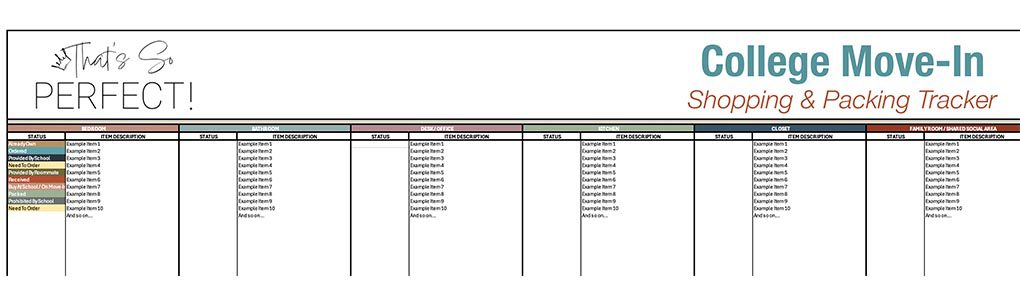
GET YOUR FREE SHOPPING & PACKING TRACKER FOR COLLEGE MOVE-IN!
We’ve created a free master shopping and packing tracker tool to help you keep up with everything your student needs for moving day. No need to stress over forgotten or misplaced items, or worry if you actually ordered that item that your student really, really wanted. Just fill in the short form below to download the file for free.
We’re Here To Help – Ask Us Questions & Share Your Own Advice
We hope you’re finding these resources to be helpful as you prepare with your student the move to college. Drop a comment below if you have additional suggestions. If you’ve already sent a kid to college, what were the big surprises that you didn’t account for? What did you do that other parents have since told you is a great idea? Let’s help all the other moms out there by sharing our best advice!
Cheers, lovelies!


