

This post is part 2 of a multi-part series, developed in collaboration with a rising senior at the University of Tennessee and her mom (founder of That’s So Perfect! Lori Parsons). We’ve revisited everything we did to get her ready for her freshman year – the successes, the mistakes, and the things that took us completely by surprise). Together, Callie and I scoured numerous books and online resources and talked to other experienced and newbie college parents. The result is a consolidated set of easy-to-follow guides for you and your student. The guides cover everything from financial readiness and personal safety to what to buy for the dorm. We’ve done the planning, the list-making and the organizing for you. We’ve put together a collection of the best products for you. Take a deep breath and relax. We’ve got your back!
Can you hear that clock ticking, like an Edgar Allen Poe story? Tick Tock. Tick Tock. Nothing made me more aware of the limited time I have left with my kids than counting down to college move-in day. That date sat in my gut for months. As we approached her high school graduation, it felt like the slow tick tock of the clock suddenly converted to a high-speed train racing through the calendar. The more that I wanted to slow down time, the faster it flew by.
Now that you’re about 3 months out from the moving date, there are some really, really big topics you should cover with your student. In the scurry to find dorm room decor and buy fan gear, it’s easy to lose sight of some really big rocks that need to be addressed with your student. This section has an emphasis on class registrations, tuition savings tips, and personal safety. As I mentioned in the Part One of this series, our goal is to provide you and your student with tips to increase their confidence, success, safety and independence as they embark on their first year of college or trade school.
Here is an outline of the topics covered in this post to ensure you and your college student have a successful move to college:
7 Big Things To Do In The 3 Months Before Your Student Goes To College or Trade School
1. Per the instructions from the university, your student select their desired dorm around this time. This step also includes selecting their roommate (entering the name of desired roommate in the form when they select their desired dorm.) The school will have a lot of info about the different dorms. It’s becoming increasingly popular that the schools housing department has its own social media account. Those accounts will usually have video tours and floor plans of the dorms. I’ve seen parents go absolutely psycho about dorm selection. Don’t. Do. That. You’ll create unnecessary stress for you and your student.
Accept that while your student may be given the option to rank dorms to their preference, at the end of the day it just depends on inventory and demand. Your student may not get their first or even their second choice. If that happens, everyone will survive. Just go with the flow on this one. There are so many other things to worry about that are far more important than getting your first choice of dorms.
2. Within the official school website, locate the student housing area. Download information on the dorm your student will be living in, such as floor plans and measurements. They may also provide a checklist of things your student will need to bring and a list of what is not allowed. If your student is living in an apartment / non-university housing, find the floor plans with measurements.

HOUSING INFO: If you can’t find this info on the student housing website, ask for help in the unofficial parents’ groups on social media. One of the groups that I’m in for UT parents has created files of the dorm room layouts and measurements. Parents posted before and after pics of the room decor. I found a ton of helpful detail by searching through that group and just asking questions live.
3. If your student has secured a roommate, have them introduce you to the parents via text message. Often, roommates will divide the items to be purchased for common use. It’s helpful to have met the other parents in case big purchases need to be agreed upon (tv, microwave, refrigerator, printer, etc.)
ROOMMATES: Yes, your student can and should manage a lot of this on their own as part of their evolution into adulthood. However, it never hurts to have the contact info of the roommate’s parents. Even if your student doesn’t plan to coordinate any décor or purchases with their roommate, it’s a good idea to at least meet the roommate and their parent(s). If your student has an emergency while at school, the roommate may need to contact you, or vice versa. Parents may want to connect with each other if there is a school wide emergency. Better safe than sorry.
4. Determine if you’ll need to have any utilities or other services set up for your student’s residence. If student housing, it’s typically provided by the university. If it’s non-university housing then it’s similar to moving yourself into a new house or apartment. They may need to set up power, water, cable / internet and sometimes there can be a lead time.
FINANCIAL: If it turns out you do have to set up utilities, set them up in your student’s name. This will help feed their credit history file. Although not a primary source for credit scores, it does help “thicken” their credit file overall. This is a good thing, as long as you and / or your student pays the bills on time. Most utilities will allow you to set up text and email reminders to more than one address. You can always add your contact info as secondary to your student to make sure things are getting paid.
5. If your student is starting college in the fall, then over the summer they will be scheduled to meet with their university advisor. These days, it’s usually a virtual meeting. The advisor will identify the classes your student should register for that fall semester. If your student’s school hosts an in-person orientation, then the advisor meeting may happen there. Most schools won’t allow students to register until after that advisor meeting. Make sure your student is checking their university email daily and scheduling their advising appointment at the earliest possible date.
SIGNING UP FOR CLASSES – ADVISORS: Before they meet with their advisor, make sure your student is well-versed in the course requirements and pre-requisites for their major. This information is available on the school’s website for their major, along with the course catalog. Classes at most universities fill up quickly and freshman are often prioritized last. Seniors are slotted into classes first to ensure they can graduate on time. Don’t be surprised if your student can’t get into every class they want. If their first choice of class is full, your student may need to make changes to their registration after the advisor meeting to find other suitable classes. Since every credit hour could literally cost you hundreds or thousands of dollars, neither you nor your student want to waste money on courses they don’t need to graduate. My daughter felt that sometimes advisors would suggest filler classes without concern about budget. There’s no judgement against the advisors. Being an advisor is a thankless job with infinite variables so there’s no way an advisor can be expected to know every detail unique to every student. My daughter always made sure she knew all of the ins and outs of her major of study and often changed her class plan to be different than what her advisor suggested. Make sure your student completes their class registration as soon as they’re allowed and definitely before the deadline. Tuition invoices are based on class registration credit hours.
SAVING MONEY – METHOD #1: There are two “easy” ways to save money that may be available to your student. The easiest method is to take advantage of community college courses that are virtual and transferrable to your student’s university and major. My daughter took several community college courses in a virtual format at the same time she was taking in-person classes at her primary university. One class was notoriously hard at her college, so she took it at the community college instead. Another class was really hard to get into because so few options were offered at her primary university. She took that one at CC as well. The key is to make triple sure the course is transferrable by checking with your university. Most schools publish a list of “equivalent” courses that can be taken at CC’s in surrounding states. If your student is considered out of state at their primary college, have them take the CC classes in your home state to save even more on tuition. Make sure you do an extra check if your student has a scholarship – there may be requirements about the # of credit hours that must be taken each semester at their primary university.
SAVING MONEY – METHOD #2: Another way to potentially save money applies to out-of-state students in certain states. This program enables students to study a specialized field out of state while paying in-state tuition rates at participating colleges and universities. It is intended to close the gap when a certain major isn’t offered in the student’s home state that forces that student to go out of state and pay more. There are about 15 states that participate, mostly up and down the east coast and stretching west to Texas and Arkansas. We were able to take advantage of this program for 2 1/2 of my daughter’s four years because the Supply Chain and Logistics major is not available in Virginia but it is available at UT. It save us 50% on tuition during the semesters she was eligible! We weren’t able to leverage it all four years because she changed her major midway through her junior year to Communications, which isn’t a common market option for Virginia students. Learn more and check to see if your college participates in the Academic Common Market or ask if there’s is a similar program in your region of the U.S.
SIGNING UP FOR CLASSES – SCHOLARSHIP IMPACTS: As your student makes adjustments to class registration, make sure they’re staying above the minimum credit hours required to designate them as a full-time student. Many scholarships require the student to be enrolled in a minimum number of credit hours per semester. In the parent groups that I participate in on social media, I’ve heard parents tell horror stories about their students losing their scholarship because their advisor didn’t know all of the requirements and inadvertently guided the student in a direction that cost them their scholarship. NOTE: This is not the advisor’s fault. No advisor can be expected to know every detail of every scholarship in the universe. This is solely the responsibility of your student, and you if you’re footing the bill for their tuition.
SIGNING UP FOR CLASSES – PROFESSOR RATINGS, VIRTUAL VERSUS LIVE AND COURSE REQUIREMENTS: When selecting courses during registration, students can check for student ratings of the professor on www.ratemyprofessor.com. This site collects ratings from students across many universities about each professor and the difficulty of the class, teaching style, etc. My daughter always referenced it before picking classes when multiple professors were available for a certain course. Your student should carefully note whether the class is virtual or live and choose a format that works best for their learning style.
6. Have a LOT of talks about the danger of drinking too much, and especially of being roofied. Students are going to drink. Even if you believe your student won’t drink, others around her / him will drink. Have real, open conversations with them about how to avoid putting themselves in a dangerous situation. Also talk about what to do if they find themselves in a scary situation. If it takes instilling a healthy dose of fear in them, then do it. Remember, this isn’t a gender-specific problem! Both men and women can drink too much or be roofied and become vulnerable to sexual assault. When you reach the point that you think you’ve talked this subject to death, go have the conversation with your student 10 more times. It will never be enough.
PERSONAL SAFETY – BUDDY SYSTEM AND LOCATION APPS: Make your student promise to follow the buddy system. Never walk alone. EVER. Even if you’re with a buddy, have a rule with the roommates to text each other when they leave a class / bar / store, when they get into an uber, and when they arrive home. My daughter, her friends and her sorority sisters all keep their Snapchat locations turned on so those in their Snap groups will be able to locate them. If Snapchat isn’t your thing, then I highly recommend a family subscription to the Life 360 app. It’s cheap, easy to use, and gives everyone peace of mind. I still have a deal with my college senior daughter: I promise never to comment on where she went or what time she got home, I just want to know that she made it home because I equate her making it home with “she’s alive.” She knows she will forget to text me, so Life 360 is our lazy way of knowing that she made it home. Her first semester I checked it on weekend mornings just to be sure she made it back to her apartment. I check it less so now, unless she tells me it’s a big party weekend on campus. She has told me multiple times over the years that it gives her peace of mind to know that we can find her in the event of an emergency. I also like the Life 360 App because it gives driving info. Since my daughter has to drive ~7 hours each way up and down I-81 to get home from school, it gives me peace of mind to be able to check in on her progress. I’ve put enough fear of the gods in my kids that they voluntarily leave their app turned on for their own safety.
ALCOHOL & DRUG CONSUMPTION, ROOFIES & SEXUAL ASSAULT: Teach your student never to take a drink given to them from someone else. Teach them to never, ever take their eyes off of their own drink and to always keep it covered. I bought these for my daughter and she used them vigilantly (affiliate link to Amazon): Drink Cover Scrunchie. Talk to your student about knowing their limits for alcohol consumption. If they’ve only had one drink but they feel like they’ve had 10, they should consider it a red flag and IMMEDIATELY have a buddy take them home and watch them (or to the ER if appropriate). This isn’t just an alcohol problem. If weed is your student’s vice of choice, then buy them test kits for fentanyl (you can find test strip kits on Amazon). With the rise in fentanyl overdoses and weed being laced with it, your student might consider keeping the test kits on hand. Don’t stick your head in the sand, and don’t let your student be naive. Talk to your students about sexual assault, about how to report it and WHY it’s important to report it. 90% of all campus sexual assaults involve alcohol. Share educational resources with your students so they know it’s not just “mom’s paranoia.” (See resource links at the end of this post). TRUST ME ON ALL OF THIS, PLEASE, PLEASE, PLEASE. Even when at home with us around the pool, my daughter will only drink out of a cup that has a lid, and when we’re at a bar together she never takes her hand off of the top of her cup. She learned the hard way when she was roofied at a party even though she considered herself vigilant. Many of her friends have been roofied over the years. You would be terrified at how easy it is for a-holes to drop something into the drink of an unaware person. This is an area where a healthy dose of fear is a good thing.
Sexual assault on college campuses happens more often than you want to think about, and it’s NOT just women who are assaulted. 1 in 5 women and 1 in 16 men are sexually assaulted while in college. 31% of transgender persons experience some form of sexual violence during their time at college. More than 90 percent of sexual assaults go unreported. Nearly two-thirds of college students experience sexual harassment. Just as horrifying is the reality that nine 9 out of 10 female college-age victims of rape and sexual assault know their offender.*
7. Buy personal safety devices for your student. Look for small items your student can carry with them (that don’t violate the university’s policies). My daughter and her sorority sisters carry Mace (pepper spray) and a Birdie personal safety alarm [Both affiliate links go to Amazon]. I recommend buying 2 or 3 sets of mace. Buy more than one Birdie. Keychains, backpacks, in their car – there are a lot of locations that make good sense for your student to always have these items on hand. Make it easy for them. If you expect them to unclip the Birdie from their keyring and then clip it to their backpack or purse, you’re risking they’ll think it’s too much trouble. Then your student will end up without any safety devices nearby. I may sound paranoid, but I’d do anything to make sure my kids are as safe as possible.
PRACTICE USING THOSE SAFETY DEVICES: Make them practice how to use the devices you purchase. Be careful not to get mace in your / their eyes when practicing! In a fight-or-flight situation, you don’t want your student to be untrained on using pepper spray or unaware of how much strength it takes to actually yank on the Birdie to trigger the alarm. Their reaction should be second nature, no thinking required. Practice!
INSTINCTS & SELF DEFENSE: Teach your student to trust their instincts. If they have a weird vibe about a person or a party, they should trust it and leave immediately (with a trustworthy friend). Consider investing in a self-defense class. Make it something you and your student go to together. Most local police departments offer free or low-cost self-defense classes, often they’re only a 1-day session. University police departments also often offer them to students for free. I’ll say it again – these are not just suggestions for female students. These are good ideas for every student.
SCHOOL POLICY FOR SEXUAL ASSAULT: Ask the school how they handle sexual assault. Ask them for stats from the last 5 years. The last comprehensive national study was done in 2014, and determined that 40% of colleges and universities reported ZERO investigations of sexual assault in the preceding five years. That should not reassure you the school has no problems with sexual assaults. Just the opposite, that should raise a giant red flag about their policies and a culture of ignoring sexual assault or not having enough resources (both police and educational) to follow-up on reports of assault. Here are some questions provided by the National Sexual Violence Resource Center to ask your student’s Campus Police, Student Affairs, and the Dean of Students:
• Where can I review the policies and procedures used by this institution to respond to a report of sexual assault?
• What sexual assault training is provided to faculty and staff, including resident assistants?
• What counseling or services are available for victims of sexual assault, both on and off campus?
• How can I learn more about what this campus is doing to prevent sexual assault and support victims?
Sexual Assault Education & Support Resources
[icon name=”circle-info” prefix=”fas”] National Sexual Violence Resource Center (*statistics mentioned throughout this post are from their website)
[icon name=”circle-info” prefix=”fas”] RAINN, the nation’s largest anti-sexual violence organization, created and operates the National Sexual Assault Hotline in partnership with more than 1,000 local sexual assault service providers across the country.
[icon name=”circle-info” prefix=”fas”] Website locator tool (provided by RAINN) to find independent sexual assault service providers, including National Sexual Assault Hotline affiliate organizations and other local providers of support. Staff at these programs are dedicated to helping survivors in their local area.
[icon name=”circle-info” prefix=”fas”] OneLove, a national non-profit with the goal of ending relationship abuse. Their mission is to empower young people with tools and resources to see the signs of healthy and unhealthy relationships and bring life-saving prevention education to their communities

More Helpful Posts In This Multi-Part College Prep Series
Now go back and read parts 1 & 3 in the series to make sure you have your t’s crossed and your i’s dotted. Here’s a recap of the great info you’ll find in the other posts in this multi-part series designed to ensure you and your student have a successful college move-in day:
- Part 1: 8 Things You Should Do In The 4 – 6 Months Before College Move-In. This post covers everything you need to know about long lead-times or deadlines like setting up school accounts, searching for a roommate, orientation, sources for school / dorm information and how to connect with other parents at your university. In Part 1, we also teach you about the critical life skills necessary for your student to successfully live on their own. You’ll learn about legal preparation required for emergencies such as authorized access to your student’s university accounts, power of attorney for access to checking and credit accounts, and medical directives. These legal documents will allow you to make medical decisions if your student is unable to do so for him/her/themselves. Without these things in place, you and your student may find it difficult to navigate their freshman semester.
- Part 3: 15 Things Every Parent Should Do Right Now To Make Moving Your Kid To College Easier For Both Of You. In this post, we teach you how to tackle all that shopping, organizing and packing in the most efficient way possible. We also provide you with tips for using your 529 college savings plan to pay tuition, including warnings about 529 plan “surprises” that stress out many new college parents. Lastly, you will learn how to navigate the actual moving day with ease.
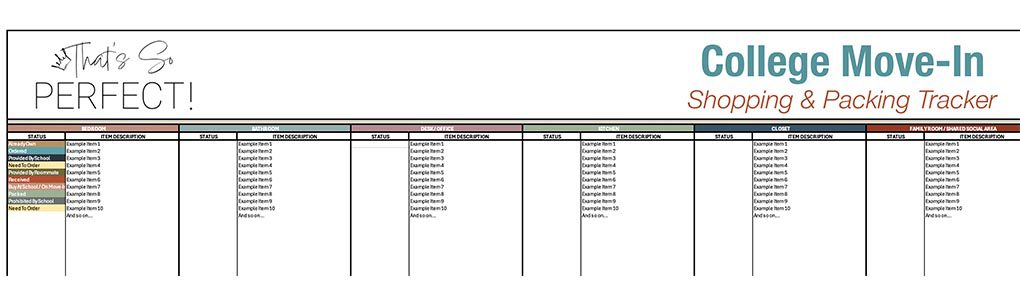
Get A FREE Shopping & Packing Tracker for College Move-In Day
We’ve created a FREE shopping and packing tracker tool to help you keep up with everything your student needs for moving day. You can download it via the form just below the example picture. We also have a 90-second reel showing you our most awesome hack for making sure everything will fit in your car when you pack. You can watch that here: The Packing Hack That Will Blow Your Mind.
Shopping Lists And Product Recommendations
Make sure you shop our curated collections of recommended items your student may need for dorm / apartment-life by the end of this week as well. You can shop the lists here:
- A Comprehensive List Of Everything Your Son Needs For A Successful College Move-In Day
- Everything Your College Daughter Needs For A Successful College Move (Curated By Experienced Parents & Students)
We really hope you’re finding these resources to be helpful as you prepare with your student the move to college. Drop a comment below if you have additional suggestions.
If you’ve already sent a kid to college, what were the big surprises that you didn’t account for? What did you do that other parents have since told you is a great idea? Let’s help all the other moms out there by sharing our best advice in the comments section below.
Cheers, lovelies!


