
A Multi-Part Series To Help Women Over Age 40 Combat The Effects Of Perimenopause & Menopause
Let me say this as plainly as possible: I do not want to end up in a nursing home or the hospital later in life. Did you know that approximately 67% of nursing home residents are women?1 Two of the top reasons women require nursing homes are due to frailty and declining cognition. We can’t move without hurting ourselves and we can’t think clearly enough to care for ourselves. Research indicates that the decline in estrogen resulting from the transition to menopause plays a significant role in reduced bone density, severe muscle loss and decreasing brain function. There are several steps menopausal women can take to combat the negative health effects from loss of estrogen, ranging from hormone replacement therapy to daily supplements, exercise and nutritional changes. I have several of these tools in my own menopause toolkit, but in this post I’ll focus specifically on why I take creatine daily to prevent frailty, dementia and muscle loss. Please remember that I’m not a medical professional. I’m sharing what works for me. You should always consult with your healthcare team to determine what’s best for your unique situation.
Decreased Estrogen During Menopause Negatively Impacts Your Bones, Muscles and Brain
The decline in estrogen that occurs during menopause significantly speeds up bone loss. Rapid bone loss contributes to the onset of osteoporosis. Ultimately, the outcome is brittle bones that are more prone to breakage. 50% of women over age 50 will break a bone because of osteoporosis. 2 Other common symptoms of osteoporosis include height loss, back pain and receding gums (bone loss in the jaw).
Menopause-related decreases in estrogen also accelerate muscle loss. 80% of menopause patients suffer from musculoskeletal issues. For 20% of those women, it becomes a debilitating symptom that interrupts their way of life. Muscle-wasting and loss of muscle function is called Sarcopenia and is a relatively newly recognized condition. The presence of Scarpenia in women increases around age 50, causing a decline in muscle mass of an additional 0.6% above the expected 1 – 2%.3 Poor musculoskeletal health leads to frailty and loss of mobility and balance. Ultimately, the result is a higher incidence of falls and fractures.
Menopause-related decreases in estrogen also accelerate muscle loss. 80% of menopause patients suffer from musculoskeletal issues. For 20% of those women, it becomes a debilitating symptom that interrupts their way of life. Muscle-wasting and loss of muscle function is called Sarcopenia and is a relatively newly recognized condition. The presence of Scarpenia in women increases around age 50, causing a decline in muscle mass of an additional 0.6% above the expected 1 – 2%.3 Poor musculoskeletal health leads to frailty and loss of mobility and balance. Ultimately, the result is a higher incidence of falls and fractures.
One of estrogen’s many roles is neuro-protective. As estrogen declines, it impacts the parts of the brain that control learning, memory, mood, temperature and sleep. 80% of women experience declining neurological capabilities during their menopause transition.5 Until recently, menopause wasn’t even on the radar of neurologists, but new studies are shining a light on the effects of estrogen loss on neurological function. In fact, a recent study found that menopause is the number one predictor of Alzheimer’s changes in women’s brains.
What Is Creatine?
Creatine is a naturally occurring amino acid produced in the human body. Our liver produces less than 1g per day after we consume protein. 95% of creatine is stored in our muscles, the other 5% is stored in our brain and gut. It’s responsible for generating energy for our cells and powers all of the fast, high-energy, demanding activities our body experiences every day.
Less than 1g per day of naturally produced creatine isn’t enough to overcome the negative effects of estrogen loss on our energy, muscles, and cognition. This deficiency is made worse because women naturally produce about 70% LESS creatine than men.4 While you can consume small amounts creatine from eating red meat and fish, it’s impossible to hit a level equal to what you can obtain from supplementation.
How Creatine Helps Combat Prevent Frailty, Dementia And Muscle Loss During Menopause
Creatine combats osteoporosis caused by the menopausal reduction in estrogen. Studies show that creatine reduces inflammation and oxidative stress and increases bone formation when combined with resistance training. A recent study of menopausal women demonstrated that creatine supplementation reduced the rate of bond density loss in the hip region and increased femoral width.6
Supplementing creatine also helps build muscle mass, strength and a faster recovery. When you exercise, creatine helps replenish your energy levels. You won’t get as tired as quickly and your muscles won’t run out of “power”. You can sustain a more intense workout and lift heavier. Creatine also helps fuel faster muscle growth and muscle recovery by drawing more water into the muscles. All combined, creatine enables you to fight back against Scarpenia caused by menopause.
An unexpected benefit of creatine is its ability to improve cognitive function and mood. Studies show a properly functioning creatine process helps the brain maintain moderate mood. Similarly, without enough creatine on board, energy production required to support neurological processes is impaired. The extra stress and energy required to combat the effects of declining estrogen on learning and memory requires more than the naturally available creatine in the female human body. Creatine supplementation is the most effective way to boost the available creatine stores for these “high energy demand” processes.
Important of weight-bearing exercise, 30 min per day at least 3 days per week, ideally more. walk with a weighted vest (LINK), weightlifting, low-impact resistance training such as pilates.
How Much Should I Take?
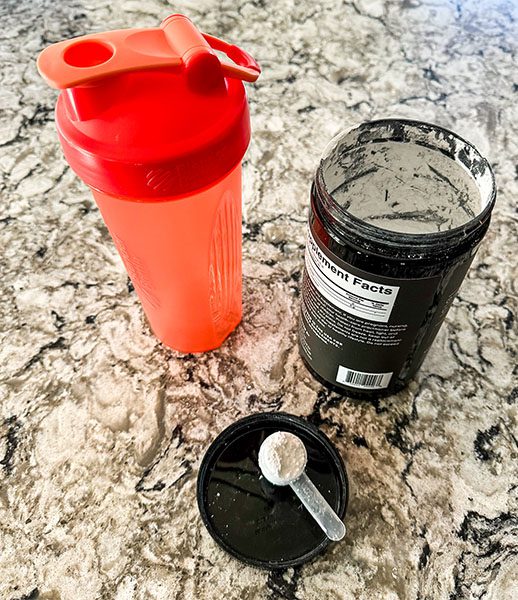
The recommended dosage is 5g of creatine monohydrate daily added to any liquid / drink. The “monohydrate” form is critical. It means it’s the bioavailable version (meaning you can absorb more of the nutrients). Creatine is tasteless and odorless. The texture is similar to powdered sugar, so it dissolves easily in any drink. Pictured to the left is one scoop, which is a 5g serving. Athletes usually prefer to drink it 30 minutes before a workout or up to 60 minutes after a workout. It doesn’t have to be consumed pre or post workout, the important part is that you are saturate all of your body’s creatine stores. It can take about 3 weeks to fully saturate your muscles to begin to see a difference.
For maximum benefit, combine with low-impact strength / resistance training to boost the bone and muscle building benefits.
I recommend brands that don’t have any extra additives. I like this brand sold on Amazon (affiliate link): Nutricost Creatine Monohydrate Micronized Powder (1 KG) – Pure Creatine Monohydrate or Dr. Mary Claire’s brand The Pause Life (not available on Amazon, you have to order directly from her site here. I prefer to mix mine in a blender bottle to help it dissolve. My favorite is the Blender Bottle Classic Shaker.
Creatine Myths Debunked
- All of these supplements are “voodoo hocus hocus.” How do I know creatine is safe?
- Creatine is THE most researched fitness supplement on the market. The International Society of Sports Nutrition (ISSN) declared it the most effective nutritional supplement available, and the European Food Safety Authority (EFSA) recommends creatine supplementation to adults over the age of 55. 7
- Creatine causes kidney problems
- This is a common misconception because people get confused about creatine and creatinine in the kidney. Research shows that even at doses 8 times higher than the recommended 5g, there is no kidney damage
- Creatine will make me bulk up like an Olympic weightlifter
- LOL, only if you’re consuming the same amount of creatine as an Olympic weightlifter and lifting the same weights as an Olympic weightlifter. Bodybuilders load creatine at an average of 4 times more than the 5g recommended dose and combine it with insane amounts of carbs. Then they lift VERY HEAVY things.
- Creatine will make me bloated
- Bloating typically only happens if you are doing a “loading” phase. This means you temporarily increase beyond the 5g dosage to speed up the saturation in your muscles from 3 weeks to some period shorter than 3 weeks. Part of creatine’s job is to draw water into muscle cells, so if you choose to do a loading phase, you may feel that increased water retention during loading. If you’re worried about it, then don’t do a loading phase. If you take the low dose of 3-5g daily, it’s unlikely that you’ll experience bloating. I’ve been taking 5g daily for a week and haven’t had any issues.
Build Your Menopause Toolkit And Take Control Of Your Health Today
I may be only 52 years young, but I’m already aggressively building my menopause toolkit. There are estrogen receptors in every organ of the female body. The decline of estrogen during menopause has a significant and negative impact on our health and our lives. I’m not giving up without a fight, and you shouldn’t either. For more menopause support, check out our post that explains a little more about menopause symptoms and what treatment options are available to help manage them: Alleviate Your Menopause Symptoms Now With These 8 Different Treatment Options. We also recommend Dr. Mary Claire Haver’s book as an excellent doctor-authored guide to all things menopause. It has become our bible around here. You can purchase it on Amazon (affiliate link) here: The New Menopause: Navigating Your Path Through Hormonal Change with Purpose, Power, and Facts
Cheers, lovelies! Here’s to good health, healthy muscles and bones and a high-functioning brain!

Lori
DISCLAIMER: Please remember that I’m not a medical professional. I’m sharing what works for me. You should always consult with your healthcare team to determine what’s best for your unique situation.
Sources
1,7US News & World Report: Nursing Home Statistics: What to Know in 2024
2Dr. Mary Claire Haver, M.D., The Pause Life: Breaking The Silence: Demystifying Osteoporosis And Bone Health
3 National Institutes of Health: Musculoskeletal Disorders & Menopause by Suvarna Satish Khadilka, OB / GYN
4 Women’s Health Magazine: Creatine Is The Most Researched Fitness Supplement, Here’s Why Women Need It
5 Weill Cornell Medicine, Dr. Lisa Mosconi M.D., Director of Women’s Brain Initiative
6 Dr. Mary Claire Haver, M.D., The Pause Life: The Benefits of Creatine


